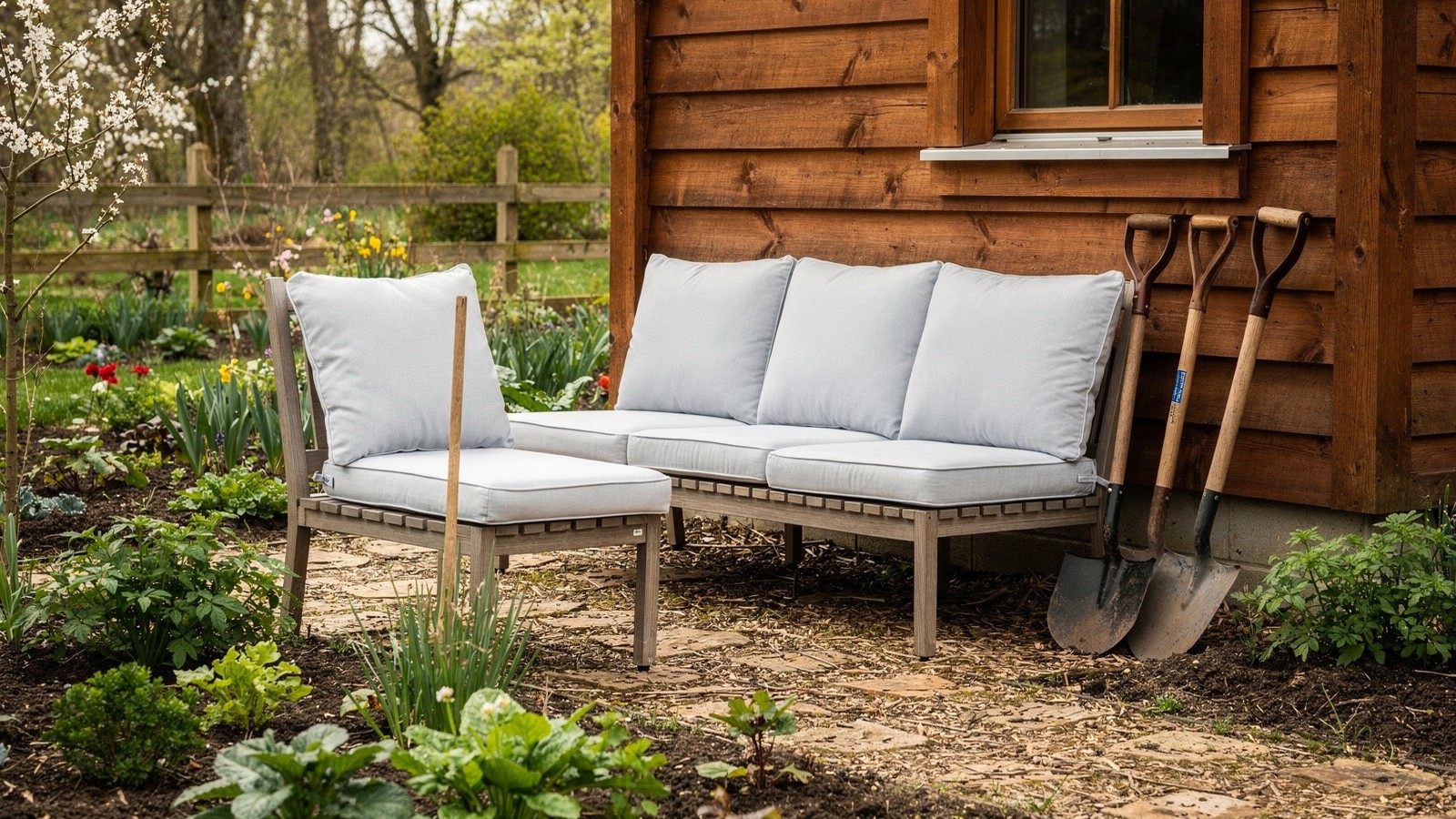
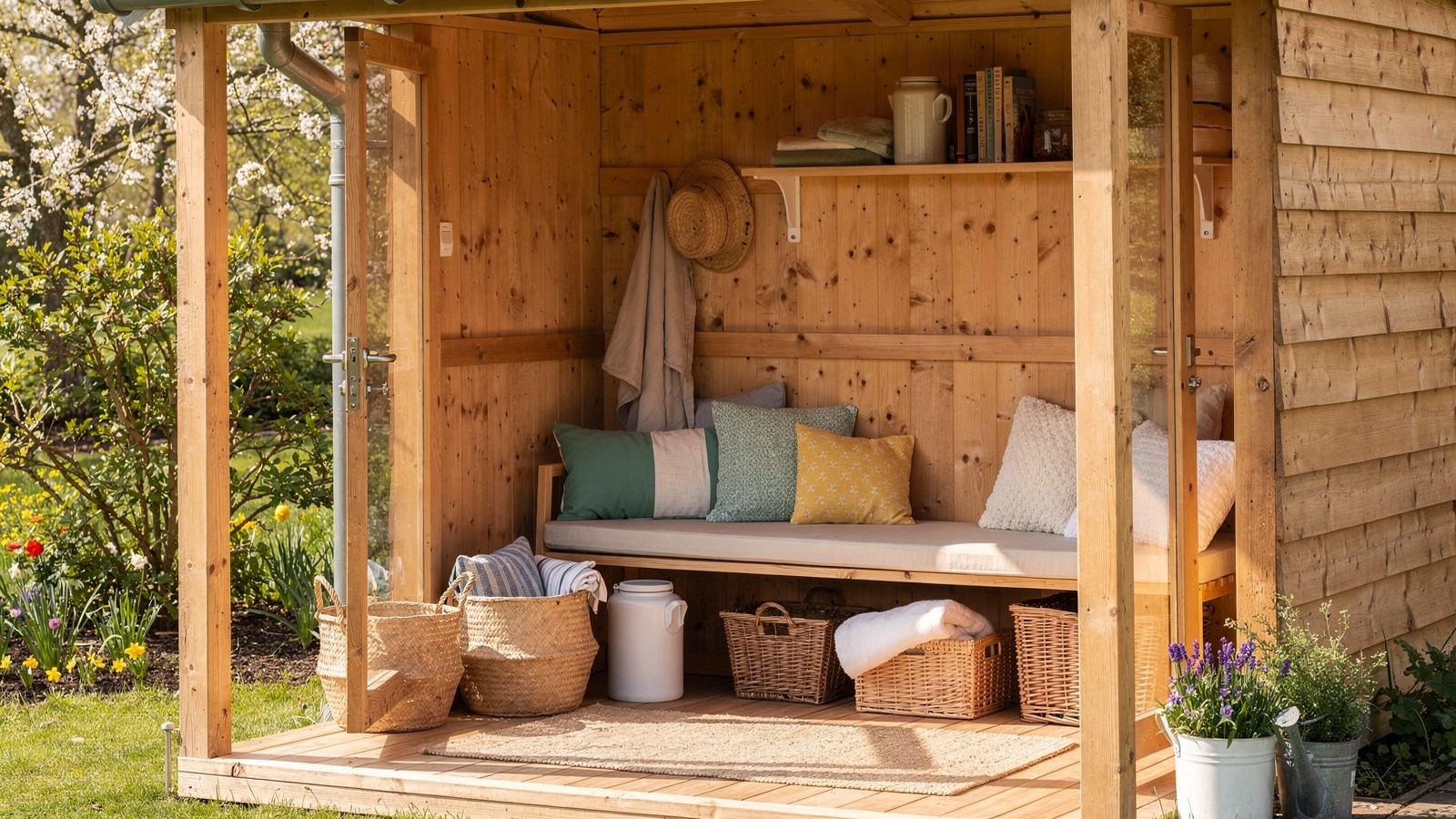
Spring is when the cabin outbuilding goes from “nice idea” to “why is this still full of paint tins?”—fast.
If you’re the operator in a shared place (or the person who always ends up acting like one), you already know the real friction: it’s not the work. It’s the invisible work. Someone buys cushions, someone else stores tools under the bench, and suddenly the space feels cluttered, tastes clash, and nobody can point to what “done” looks like.
This is a one-day refresh that avoids the usual failure mode: a big push, then a slow slide back into “temporary storage.” The trick is choosing upgrades that look good *and* make responsibility clear.
Below are five practical changes that work repeatedly in garden rooms, porches, sheds, and small cabin outbuildings—plus a simple one-day run order so it actually happens.
1) Set one “personal zone” (so decor doesn’t become storage)
Most shared outbuildings fail the “shared use” test because personal items arrive with no rules. One person’s “character” is another person’s “clutter.” The fix isn’t banning personality—it’s giving it a boundary.
What to do (30–60 minutes):
- Pick one “personality zone.” A single shelf, wall strip, or cabinet top that’s allowed to hold personal items.
- Choose 5–10 items max that reflect how the space is actually used: books you’ll re-read, a record player you’ll play, a board game people request, a craft basket you’ll open weekly.
- Use display, not piles. If it can’t sit upright, hang, or live in a container, it’s probably not decor.
Ideas that work well in a compact shared space:
- Hobby pieces (a first golf club, a framed event ticket, a small tackle box if it’s genuinely used)
- A short stack of favourite books (not the entire “to read” backlog)
- Records or a compact speaker setup
- A craft tray with the current project only
Operator tip: Label the boundary. Literally. A small tag inside the shelf (“Display shelf: max 10 items”) stops the slow creep back into chaos.
2) Add “low-drama” plants (so it looks cared for without a watering argument)
Plants are the fastest way to make a timber outbuilding feel like part of the garden rather than a shed-with-seating. They also signal “this place is looked after,” which matters in a shared setup.
The mistake is choosing plants that need perfect light, perfect watering, and perfect memory. In a small seasonal outbuilding, conditions swing: cold nights, hot afternoons, inconsistent use.
What to do (20–40 minutes):
- Add one statement plant (height or volume) and two smaller plants.
- Put them in matching pots (it reads as intentional).
- Decide the watering owner: one person, one schedule.
Hardy, low-drama options to consider:
- Kalanchoe: compact, colourful, doesn’t demand constant attention.
- Areca palm: gives that “garden room” feel quickly with height and softness.
- Pineapple plant: fun, conversation-starting, and often described as air-purifying.
Placement that avoids future arguments:
- Keep plants off the main table (tables become dumping grounds).
- Use a plant stand or a dedicated corner so watering doesn’t mean moving everyone’s stuff.
3) Put shared memories on one wall (so the room feels “owned,” not “borrowed”)
A shared cabin space becomes a retreat when it carries emotional cues—photos do that better than almost anything else. They also help align co-owners: it’s harder to treat the space like a storage unit when it’s clearly a place for people.
What to do (45–90 minutes):
- Choose a theme: family and friends, holidays, city breaks, or one shared tradition (annual BBQ, first summer in the house, etc.).
- Print a small set: 9–12 photos is enough.
- Use matching frames or a single photo ledge.
Make it operator-proof:
- Don’t leave it at “we’ll get around to it.” Put photos in frames the same day.
- Keep it to one wall or one ledge so it doesn’t spread.
Why this reduces friction: When the space reflects shared memories, people are more likely to tidy up after themselves. It turns “someone else’s project” into “our place.”
4) Add one storage “home base” (so the tidy look survives the weekend)
Styling is easy. Keeping it styled is the hard part.
The most reliable way to keep a shared cabin space functional is to give every category a home: glasses, games, candles, throws, charging cables. When those items don’t have a home, they end up on chairs, windowsills, and the floor—until someone gets annoyed.
What to do (60–120 minutes):
- Install one simple shelving run or a compact storage unit.
- Refresh soft furnishings with 2–4 new cushions (same colour family) and one throw.
- Create a “hosting kit” if you entertain: tray, bottle opener, napkins, and a small bin.
A fun, high-impact add:
- A retro 70s-style drinks trolley. It’s practical (it moves), it signals “this is for enjoying,” and it stops bottles and glassware migrating across every surface.
Operator tip: If multiple people use the space, agree one rule: *nothing lives on the floor except furniture.* That single standard prevents the slow slide back into “temporary storage.”
5) Change the floor “feel” (for the fastest before/after)
If you want the biggest “before/after” without buying furniture, look down.
Floors set the tone. They also show wear first—mud, scuffs, water marks. A floor refresh makes the whole room feel cleaner even if you haven’t changed anything else.
Option A: Painted, stencilled tile effect (high impact, more prep)
- Use floor paint plus stencils to create a tile pattern.
- Works especially well in smaller outbuildings where a bold pattern reads as intentional design.
Option B: Outdoor rug by the entrance (fastest win)
- Put a weather-friendly rug just inside the door.
- It adds warmth, reduces dirt spread, and makes the space feel finished.
Operator tip: If the space is shared, the rug is often the better first move. It improves cleanliness immediately and doesn’t require everyone to respect drying times, ventilation, or paint care.
One-day run order (so it doesn’t turn into a negotiation)
If you want this done in a day without it turning into a group decision marathon, run it like a simple ops sprint:
1. Reset (30 minutes): clear surfaces, remove anything that doesn’t belong, wipe down. 2. Create the “homes” (2–3 hours): shelving/storage + decide the personality zone. 3. Make it feel lived-in (1–2 hours): plants + photos. 4. Finish the surfaces (30–90 minutes): rug placement or paint/stencil prep. 5. Lock in ownership (15 minutes): who waters, who restocks the hosting kit, and what “max items” means for the personal zone.
The issue usually isn’t the checklist. It’s that nobody knows who owns the checklist. Even in a single household, that’s where spring projects stall.
Conclusion: Make it feel better now—and easier later
A springtime cabin outbuilding revamp works best when it solves two problems at once: it lifts the mood today and reduces friction tomorrow.
Personal touches make the space feel like yours. Plants connect it to the garden. Photos make it emotionally sticky. Storage makes clutter less likely. A rug or refreshed floor changes the room’s feel instantly.
Do the visible upgrades—but don’t skip the ownership decisions. When responsibilities are clear, the space stays welcoming long after the first sunny weekend.